HVAC Energy Efficiency Ratings Explained: SEER, AFUE, HSPF
Confused by HVAC efficiency ratings? This guide breaks down SEER, AFUE, HSPF, and other ratings so Virginia homeowners can make informed purchasing decisions.
Making Sense of HVAC Efficiency Numbers
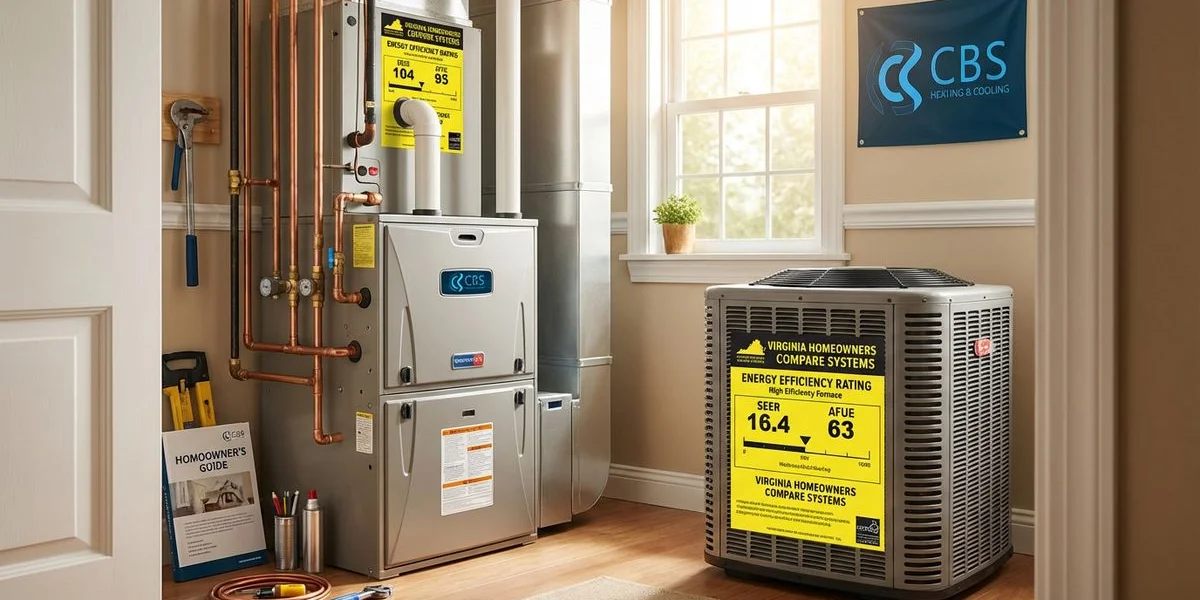
When shopping for a new HVAC system, you will encounter a bewildering array of efficiency ratings: SEER, SEER2, EER, AFUE, HSPF, HSPF2, and COP. Each measures something different, and understanding what they mean is essential for making a smart purchasing decision.
At HVAC of Virginia, we believe informed customers make better decisions. This guide breaks down every major HVAC efficiency rating in plain language so you know exactly what you are comparing when evaluating systems for your Manassas-area home.
Air Conditioner Ratings
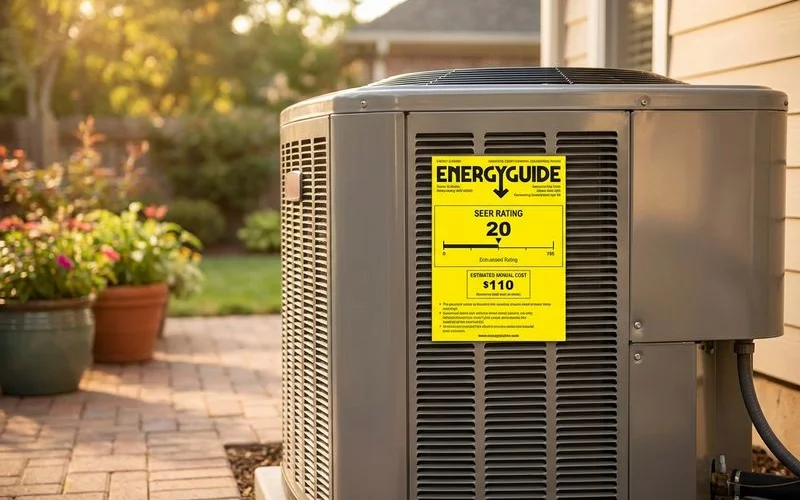
SEER and SEER2 (Seasonal Energy Efficiency Ratio) SEER is the most widely used efficiency rating for air conditioners and heat pumps in cooling mode. It measures the total cooling output during a typical cooling season divided by the total electrical energy input during the same period.
Think of SEER like miles per gallon for your car. A higher SEER number means more cooling per unit of electricity consumed. A 20 SEER unit produces the same amount of cooling as a 14 SEER unit but uses roughly 30 percent less electricity to do it.
As of January 2023, the industry transitioned to SEER2, which uses updated testing procedures that more accurately reflect real-world conditions. SEER2 numbers are generally slightly lower than the equivalent SEER numbers due to the more rigorous testing standards. A system rated at 15 SEER2 is roughly equivalent to what would have been rated at 16 SEER under the old standard.
Current Minimum Requirements for Virginia Northern Virginia falls in the South region as defined by the Department of Energy. The current minimum efficiency for new air conditioners is 14.3 SEER2 (equivalent to about 15 SEER). Systems below this threshold can no longer be legally installed.
EER and EER2 (Energy Efficiency Ratio) While SEER measures seasonal efficiency, EER measures efficiency at a single set of conditions: 95 degrees outside, 80 degrees inside, and 50 percent humidity. EER is important because it tells you how efficiently the system performs during peak conditions, which is particularly relevant for Virginia summers when temperatures stay in the 90s for extended periods.
A system with a high SEER but low EER might be efficient during mild weather but struggle during the hottest days. Look for systems that score well in both ratings.
Furnace Ratings
AFUE (Annual Fuel Utilization Efficiency) AFUE is the standard efficiency measurement for gas furnaces and boilers. It represents the percentage of fuel that is converted into usable heat. An AFUE of 96 percent means that 96 cents of every dollar you spend on gas becomes heat for your home, while 4 cents is lost through the exhaust.
Furnaces generally fall into two categories:
Standard Efficiency (80-83% AFUE): These use a single heat exchanger and vent combustion gases through a metal flue pipe. They are less expensive upfront but cost more to operate.
High Efficiency (90-98% AFUE): These use a secondary heat exchanger to extract additional heat from combustion gases. The exhaust is cool enough to vent through PVC pipe rather than metal. The highest-efficiency models achieve 97 to 98 percent AFUE, wasting almost nothing.
For Manassas homeowners considering a new furnace, we generally recommend 95 percent AFUE or higher. The price difference between an 80 percent and a 96 percent furnace is typically $500 to $1,000, but the higher-efficiency model saves $150 to $300 per year in gas costs, paying for the difference within a few years.
Heat Pump Ratings
HSPF and HSPF2 (Heating Seasonal Performance Factor) HSPF measures heat pump efficiency in heating mode over an entire heating season. Like SEER, higher numbers indicate better efficiency. The current minimum for our region is 7.5 HSPF2.
HSPF is particularly important for Northern Virginia homeowners because it accounts for the fact that heat pump efficiency varies with outdoor temperature. A heat pump might achieve a COP of 4 at 50 degrees but drop to 2 at 20 degrees. HSPF captures this seasonal variation in a single number.
COP (Coefficient of Performance) COP is the simplest efficiency measurement for heat pumps. It is the ratio of heat output to electrical input at a specific temperature. A COP of 3 means the heat pump delivers three units of heat for every one unit of electricity consumed.
COP varies significantly with outdoor temperature:
- At 50 degrees: COP of 3.5 to 4.5 (very efficient)
- At 30 degrees: COP of 2.5 to 3.5 (still more efficient than electric resistance)
- At 10 degrees: COP of 1.5 to 2.5 (older models); 2.0 to 3.0 (modern cold-climate models)
For Northern Virginia, where winter temperatures typically range from the 20s to the 40s, modern heat pumps maintain excellent efficiency throughout most of the heating season.
Energy Star Certification
Energy Star certification from the EPA identifies HVAC equipment that significantly exceeds minimum efficiency requirements. To earn the Energy Star label, equipment must meet these thresholds:
- Air conditioners: 15.2 SEER2 or higher (about 5 percent above minimum)
- Heat pumps: 15.2 SEER2 and 8.1 HSPF2 or higher
- Gas furnaces: 97 percent AFUE or higher (Northern climate)
Energy Star equipment qualifies for various utility rebates and may qualify for federal tax credits, making the higher-efficiency investment more affordable.
Real Cost Differences for Virginia Homeowners
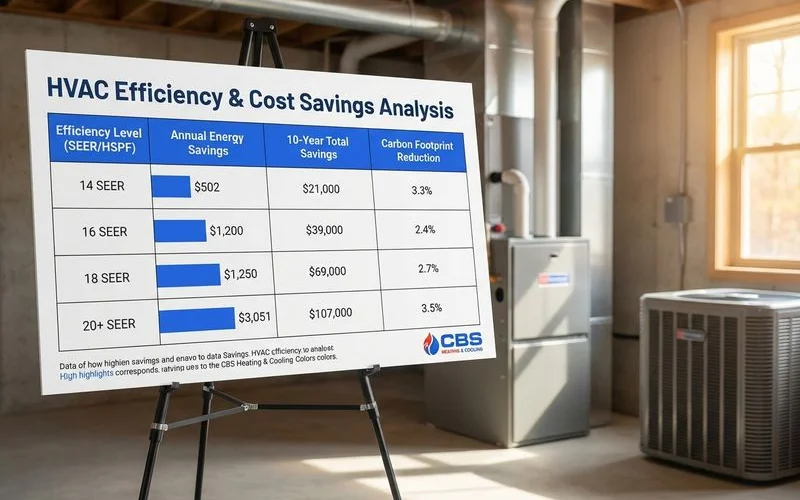
To put these ratings in perspective, here is what different efficiency levels mean for a typical 2,000 square foot Manassas home in annual operating costs:
Air Conditioning (cooling season):
- 14.3 SEER2: approximately $550 to $650 per year
- 17 SEER2: approximately $420 to $500 per year
- 20 SEER2: approximately $350 to $420 per year
Heating (gas furnace, heating season):
- 80% AFUE: approximately $900 to $1,100 per year
- 96% AFUE: approximately $750 to $900 per year
These estimates vary based on home insulation, local utility rates, personal comfort preferences, and actual weather patterns. But they illustrate how efficiency ratings translate to real dollar differences.
Our Recommendation
For Northern Virginia homeowners, we recommend targeting these efficiency levels for the best balance of upfront cost and long-term savings:
- Air conditioners: 16 to 18 SEER2
- Gas furnaces: 95 to 96 percent AFUE
- Heat pumps: 16 to 18 SEER2 and 9 to 10 HSPF2
These levels provide significant energy savings over minimum-efficiency equipment without the premium pricing of the absolute highest-efficiency models.
Get Help Choosing the Right System
Efficiency ratings are just one factor in choosing an HVAC system. Proper sizing, quality installation, and compatibility with your home are equally important. Contact HVAC of Virginia at (703) 555-0123 for a free consultation. We will help you navigate the numbers and find the right system for your Manassas home and budget.
Need HVAC Help?
Our expert technicians are ready to help with any heating or cooling issue.
Related Articles
When to Replace vs. Repair Your HVAC System
Not sure whether to repair or replace your aging HVAC system? Use this decision framework from HVAC of Virginia to make the right choice for your home.
Smart Thermostat Guide: Save Money on Heating and Cooling
Everything you need to know about smart thermostats for your Virginia home. Compare features, learn installation tips, and maximize your energy savings.

10 Ways to Lower Your Energy Bills with HVAC Efficiency
Reduce your heating and cooling costs with these 10 proven HVAC efficiency tips. Northern Virginia homeowners can save hundreds per year with simple changes.